
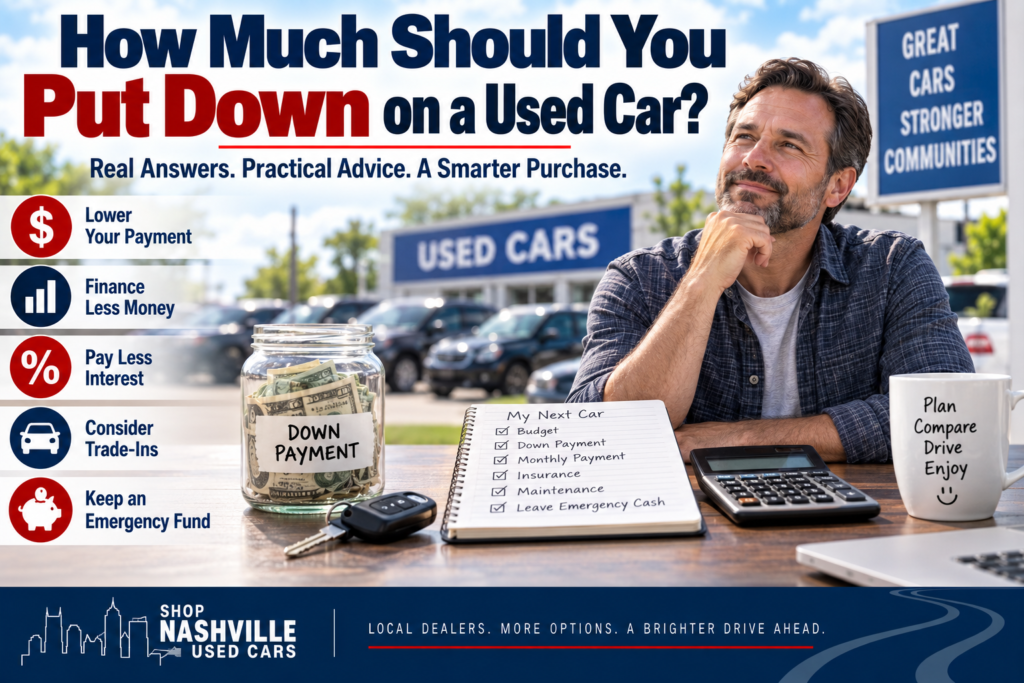
How Much Should You Put Down on a Used Car?
When you’re buying a used car, one of the first financing questions you may face is how much money to put down.
You’ve probably heard rules suggesting that you should put a certain percentage down on a vehicle. Those guidelines can be useful, but there isn’t one down-payment amount that’s right for everyone.
The better question is: How much can you comfortably put down without leaving yourself short of cash after you buy the vehicle?
Here’s what to consider before deciding.
What Is a Down Payment?
A down payment is the money you pay toward the vehicle at the beginning of the transaction.
If a used car costs $20,000 and you make a $4,000 down payment, you have $16,000 remaining before considering taxes, fees, optional products, trade-in credits, and other parts of the transaction.
The larger your down payment, the less money you generally need to finance.
Is 10% a Good Down Payment on a Used Car?
You may see 10% suggested as a starting point for a used-car down payment.
On a $20,000 vehicle, 10% would be $2,000.
But 10% isn’t a requirement that applies to every buyer or every loan. Some financing programs may require more, while qualified buyers may be able to finance a vehicle with less money down.
Instead of treating a percentage as a rule, consider how the down payment affects the entire transaction.
Benefits of Making a Larger Down Payment
Putting more money down can have several advantages.
You Finance Less Money
The most obvious benefit is reducing the amount you need to borrow.
If everything else stays the same, financing $15,000 instead of $20,000 generally means less principal on which interest can accrue.
Your Payment May Be Lower
Reducing the amount financed can also reduce your periodic payment.
However, don’t use the payment alone to evaluate the deal. The interest rate and length of the financing agreement matter too.
You May Pay Less Interest
Borrowing less money can reduce the total amount of interest you pay over the financing term.
The actual savings depend on your interest rate and loan terms.
It May Improve Your Financing Options
Depending on your credit and the lender’s requirements, a larger down payment may make a transaction easier to finance.
Lenders evaluate risk differently, so this isn’t guaranteed, but the amount you’re financing compared with the vehicle’s value can be an important consideration.
Don’t Drain Your Savings for a Down Payment
There is also such a thing as putting too much cash into a vehicle.
Suppose you have $8,000 in savings and could put all $8,000 down.
That would reduce your financing, but what happens if the vehicle needs tires two months later? What if your air conditioner at home fails or you have another unexpected expense?
Used vehicles require maintenance, and unexpected repairs can happen.
Keeping some emergency cash may be more valuable than using every available dollar to reduce your car loan.
Remember the Other Upfront Costs
Your down payment may not be the only money you’ll need when purchasing the vehicle.
Depending on the transaction, there may also be:
- Sales taxes
- Title and registration charges
- Dealer fees
- Insurance costs
- Optional products
- Immediate maintenance needs
Ask for an out-the-door price so you understand how much cash you’ll actually need to complete the purchase.
What About a Trade-In?
A trade-in can reduce the amount you need to finance.
For example, if you’re buying a $25,000 vehicle and receive $5,000 of net trade-in value after any applicable payoff, that value can reduce the amount that otherwise needs to be covered by cash or financing.
But concentrate on the complete transaction.
A dealership offering more for your trade isn’t necessarily giving you the better deal if the replacement vehicle is also priced higher.
Compare the numbers separately.
What If You Still Owe Money on Your Trade?
If you owe money on your current vehicle, find out the exact payoff amount.
Then compare it with the vehicle’s trade-in value.
If your payoff is higher than the trade value, you have negative equity.
In some transactions, that negative equity may be included in the financing for the replacement vehicle, subject to lender approval. That increases the amount you’re financing and can make it harder to build equity in the new vehicle.
A larger down payment may offset some of that difference, but make sure you understand exactly how the old loan is affecting the new transaction.
Down Payments With Bad Credit
If you have credit problems, the amount of your down payment may become more important.
Some lenders or dealership financing programs may require a particular amount down based on factors such as your credit profile, income, vehicle, and amount being financed.
Don’t concentrate solely on getting approved.
An approval is only useful if the vehicle and financing are affordable.
Review the interest rate or finance charges, loan term, payment amount, and total amount you’ll pay.
Down Payments at Buy Here Pay Here Dealerships
Buy Here Pay Here dealerships may have their own down-payment requirements.
The required amount can vary by dealership, vehicle, and financing program.
If you’re considering Buy Here Pay Here financing, ask:
- What is the required down payment?
- Does that amount apply to every vehicle?
- What is the vehicle’s selling price?
- What amount will I finance?
- What are the finance charges?
- How many payments will I make?
- What is the total amount I will pay?
A low advertised down payment shouldn’t be the only reason you choose a particular vehicle.
Should You Put Down More to Get a Lower Payment?
Maybe—but compare the numbers.
Suppose increasing your down payment by $2,000 lowers your payment.
That can be helpful, but you should still ask whether keeping some of that $2,000 in savings would leave you in a stronger financial position.
Also consider whether a different vehicle with a lower purchase price could reduce both your down payment and payment.
Should You Use a Credit Card for the Down Payment?
Policies regarding credit cards vary by dealership.
Even if a dealer allows it, consider the cost carefully.
Moving part of your vehicle purchase onto a high-interest credit card can replace one form of debt with potentially more expensive debt.
If you can’t pay the credit-card balance promptly, the interest cost may outweigh any rewards or convenience.
Can You Buy a Used Car With No Money Down?
Some buyers may qualify for financing that requires little or no cash down.
Whether that’s available depends on the buyer, lender, vehicle, and financing program.
But no money down doesn’t mean no cost.
Financing more of the transaction can increase your loan balance, periodic payment, and total financing cost.
Compare the complete numbers before deciding.
Avoid Choosing a Car Based Only on the Down Payment
Advertisements such as “$500 down” or “$1,000 down” can get your attention, but they tell you very little about the complete transaction.
You still need to know:
- Vehicle price
- Amount financed
- Interest rate or finance charges
- Length of financing
- Payment amount
- Number of payments
- Taxes and fees
- Optional products
- Total amount you will pay
The down payment is only one piece of the deal.
A Simple Way to Decide How Much to Put Down
Before purchasing a vehicle, consider these four questions:
1. How much cash can I put down comfortably?
Don’t include money you need for regular living expenses.
2. How much emergency savings will I have left?
Leave yourself some financial cushion.
3. How does the down payment change my financing?
Compare the amount financed, payment, interest cost, and total amount paid at different down-payment amounts.
4. Is the vehicle itself affordable?
If you need an unusually large down payment just to make the monthly payment manageable, you may want to consider a less expensive vehicle.
The Best Down Payment Is the One That Fits Your Finances
There isn’t a universal number that works for every used-car buyer.
A larger down payment can reduce how much you borrow and potentially reduce financing costs, but keeping adequate savings is important too.
Try to find a balance between reducing your debt and maintaining enough cash for emergencies and vehicle expenses.
Most importantly, evaluate the entire purchase—not simply the amount due on the day you buy the car.
Find Used Car Dealers in Nashville & Middle Tennessee
Ready to start shopping?
Shop Nashville Used Cars helps shoppers find used-car dealerships throughout Nashville and Middle Tennessee.
Browse local dealers, explore Buy Here Pay Here options, and compare dealerships before choosing your next used vehicle.