
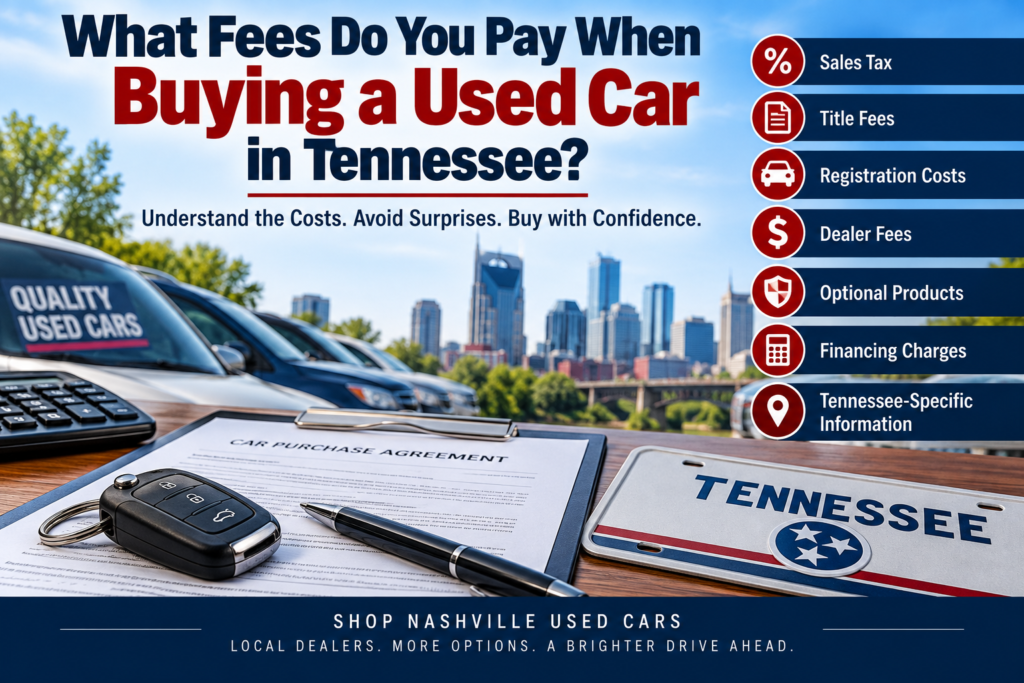
What Fees Do You Pay When Buying a Used Car in Tennessee?
The advertised price of a used car isn’t necessarily the final amount you’ll pay. When you buy a used vehicle in Tennessee, taxes, title and registration costs, dealer fees, and optional products can all affect the final price.
Understanding these charges before you shop makes it easier to compare vehicles and dealerships based on the total cost, rather than just the price displayed on the windshield.
Here’s what Tennessee used-car shoppers should know.
1. Tennessee State Sales Tax
Tennessee generally imposes a 7% state sales tax on vehicle purchases. Additional state and local taxes can also apply depending on the amount of the purchase and where the vehicle will be registered.
Because vehicle-tax calculations can involve several components, don’t simply multiply the advertised price by one combined percentage and assume that’s your exact tax bill.
Ask the dealership to show the taxes separately on the purchase paperwork.
2. Tennessee Single-Article Tax
Tennessee also has a state single-article tax.
For motor vehicles, the current rate is 2.75% on the portion of the sales price above $1,600 and up to $3,200. That means this particular component of the tax is limited rather than applying to the entire price of a typical used vehicle.
This is one reason Tennessee vehicle sales-tax calculations can look more complicated than simply applying the state’s basic sales-tax rate to the purchase price.
3. Local Sales Tax
Local sales tax can also be part of a Tennessee vehicle purchase.
The applicable amount depends on the locality, so two buyers purchasing similarly priced vehicles may not necessarily have identical tax totals if their circumstances or registration locations differ.
If you’re shopping in Nashville but live elsewhere in Middle Tennessee, ask the dealer to calculate the taxes based on your particular transaction rather than relying on a general estimate.
4. How a Trade-In Can Affect the Tax
A trade-in may affect the taxable amount of a Tennessee vehicle transaction.
Tennessee’s Department of Revenue excludes a separately itemized credit for a used item taken in trade from the vehicle’s sales price for sales-tax purposes.
If you’re trading a vehicle, look carefully at both numbers:
- The price you’re paying for the replacement vehicle
- The amount you’re receiving for your trade
A large trade allowance doesn’t automatically mean you’re getting the best overall deal if the replacement vehicle is priced higher.
5. Title Fees
You’ll also have costs associated with transferring the vehicle’s title into your name.
Tennessee titles and registers vehicles through the buyer’s local county clerk. The documentation required for a used vehicle generally includes a properly assigned certificate of title and an odometer disclosure statement when applicable.
Title-related charges that are actually remitted for titling and registration are treated differently for sales-tax purposes than dealer-imposed charges.
6. Registration and License Plate Costs
Your vehicle also needs to be properly registered.
Tennessee has state registration charges, and additional costs can depend on the type of vehicle, license plate selected, and county where the vehicle is registered.
Some counties may also impose a wheel tax.
Because these costs can vary, your county clerk is the best source for the exact registration amount for your vehicle and location.
7. Dealer Documentation or Processing Fees
A dealership may charge a documentation, processing, or preparation fee.
This is different from a government title or registration charge.
Tennessee’s Department of Revenue considers document processing and preparation fees part of the vehicle’s sales price, meaning they are generally subject to sales tax.
When comparing dealerships, ask whether a documentation or processing fee will be added to the advertised vehicle price.
A vehicle with a slightly lower advertised price isn’t necessarily the better deal if additional dealer charges make its final price higher.
8. Dealer Preparation and Other Dealer Charges
You may see other charges associated with completing the sale.
Tennessee considers charges for services necessary to complete a vehicle sale part of the vehicle’s sales price and generally subjects them to sales tax.
This makes the out-the-door price especially important when comparing used vehicles.
9. Extended Warranties and Service Contracts
You may be offered an extended warranty or service contract when purchasing a used vehicle.
These products can add hundreds or even thousands of dollars to the transaction depending on the coverage.
They’re separate from the vehicle itself, and Tennessee treats extended warranties and service contracts separately for tax purposes.
Before purchasing one, ask:
- What does it cover?
- What isn’t covered?
- What is the deductible?
- Where can repairs be performed?
- How long does coverage last?
- What does the contract cost?
Don’t judge an optional protection product only by how much it adds to the monthly payment.
10. GAP Coverage and Other Optional Products
Dealers may offer other optional products such as GAP coverage, tire-and-wheel protection, paint protection, or roadside assistance.
These products can increase the total amount financed.
Tennessee’s tax treatment can also differ depending on the particular product. For example, Department of Revenue guidance identifies GAP insurance as not subject to sales tax, while other products may be treated differently.
Decide whether you actually want each optional product before signing the agreement.
11. Financing Charges
If you finance your used car, the cost of borrowing money is another major expense.
Look at more than the monthly payment. Review:
- Amount financed
- Interest rate
- Loan term
- Monthly or periodic payment
- Finance charges
- Total amount you will pay
Tennessee excludes separately itemized interest, financing, and carrying charges from the vehicle’s taxable sales price.
However, those charges still affect what the vehicle ultimately costs you.
12. What If You Buy a Vehicle Outside Tennessee?
Buying a vehicle in another state doesn’t necessarily allow a Tennessee resident to avoid Tennessee tax.
If tax paid to another state is lower than the Tennessee amount due, the purchaser may owe the difference when registering the vehicle in Tennessee. If no sales tax was collected on an out-of-state purchase, tax may be due when the vehicle is titled and registered in Tennessee.
Check the requirements before traveling out of state solely because a vehicle appears less expensive.
Ask for the Out-the-Door Price
One of the easiest ways to compare used vehicles is to ask for an out-the-door price.
That lets you see the entire transaction instead of concentrating on one number.
Before signing, review:
- Vehicle selling price
- Trade-in credit
- Dealer fees
- Sales taxes
- Title and registration charges
- Down payment
- Optional products
- Amount financed
- Financing terms
- Total amount you will pay
If a charge doesn’t make sense, ask what it is and whether it’s required or optional.
Don’t Shop Based Only on the Monthly Payment
A monthly payment can make an expensive transaction appear more affordable.
Extending the financing term may reduce the payment while increasing the total amount paid over time.
Compare the vehicle price and complete financing terms before deciding whether the deal fits your budget.
Find Used Car Dealers in Nashville & Middle Tennessee
Ready to shop?
Shop Nashville Used Cars helps you find used-car dealerships throughout Nashville and Middle Tennessee.
Browse dealers by city, explore Buy Here Pay Here options, and compare dealerships before choosing where to purchase your next vehicle.